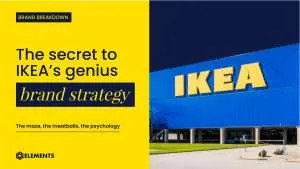
How Does Brand Strategy Connect to Business Operations? What IKEA Can Teach Growing Businesses
Brand strategy and business operations should not function as separate disciplines. Your brand defines what the business stands for; operations prove whether that promise is actually true.
Few businesses demonstrate this better than IKEA.
Flat-pack furniture, Swedish product names, enormous stores, affordable meatballs and even the route customers take through those stores can appear to be unrelated quirks. Look closer and something much more interesting emerges.
They are different expressions of the same underlying idea.
IKEA was founded around the belief that good design should be accessible to the many, not reserved for the few. That idea didn’t remain inside a brand strategy document. It influenced how products were designed, packaged, priced, named, displayed and sold.
That is what a Unified Brand looks like in practice.
At Elements, we define a Unified Brand as one aligned across every layer of the organisation — from leadership and culture to customer experience, communication and decision-making — so everyone understands who the business is, what it stands for and where it is going. Put simply, every part of the business moves in the same direction.
So, what can growing businesses learn from IKEA?
What does brand strategy have to do with business operations?
Almost everything.
One of the most limiting assumptions businesses make is that brand belongs to marketing.
Under that model, the marketing team manages the identity, messaging, website and campaigns, while other teams manage pricing, sales, customer service, product development and delivery.
Customers don’t experience those departmental boundaries.
They experience one business.
A compelling campaign followed by a frustrating onboarding process creates one impression. Premium positioning combined with bargain-led sales behaviour creates another. A promise of simplicity followed by a complicated buying process says something about your brand regardless of what your website claims.
Your operations are therefore constantly communicating.
The question is whether they’re communicating the brand you intended.
This reflects one of the principles behind our Unified Brand Framework™: a brand isn’t simply a marketing asset. It is an operating system that shapes decisions, behaviour and growth.
If you’re beginning to question whether the business and brand are still moving together, our Strategic Shifts guide can help you identify where greater clarity may be needed.
Why is IKEA’s flat-pack model a brand strategy decision?

Flat-pack furniture obviously has operational benefits.
It reduces packaging volume, makes transportation more efficient and allows customers to take products home themselves.
But stopping there misses the more important strategic point.
IKEA’s founding philosophy centred on making well-designed furniture available to ordinary people. Having customers transport and assemble products themselves helped remove costs that would otherwise increase the final price.
So flat-pack wasn’t simply an efficiency measure.
It helped make the brand promise economically possible.
That’s an important distinction for any leadership team.
Instead of asking only:
“How can we make this process more efficient?”
ask:
“How could this process make our brand promise more real?”
The best operational decisions can do both.
How does IKEA create brand consistency across different touchpoints?
IKEA’s strength isn’t one clever brand device. It’s the cumulative effect of many decisions reinforcing one another.
The video highlights six particularly useful examples.
1. Product design and flat-pack
Customers participate in the assembly process, helping IKEA maintain the affordability central to its proposition.
2. Product naming
The Scandinavian naming system continually reinforces IKEA’s origins and creates a recognisable identity that remains consistent across international markets.
Rather than becoming fragmented as IKEA expands geographically, that distinctive system travels with it.
3. Store design
The famous IKEA route takes customers through complete room settings rather than simply rows of products.
That turns a furniture store into an experience of possibility: customers see what an attractive home could look like using products they can realistically afford.
4. The restaurant
Food solves a practical customer problem. Furniture shopping can take time, particularly for families. Providing somewhere affordable to eat removes friction and allows customers to stay longer without the experience deteriorating.
5. The catalogue
For much of IKEA’s history, its catalogue repeatedly presented aspirational interiors alongside accessible prices, carrying the same proposition directly into customers’ homes.
6. Pricing
Perhaps most importantly, IKEA treats price as part of the proposition rather than something added at the end.
As discussed in the video, products can be developed backwards from the desired price point.
Put those decisions together and the pattern becomes clear.
Different touchpoints. Same underlying idea.
Consistency isn’t making everything look identical. It’s making different parts of the business reinforce the same strategic truth.
How can you tell if your operations support your brand strategy?

A useful place to start is to stop auditing only visual consistency.
Instead, audit strategic consistency.
Take your core brand promise and compare it against the moments where customers and employees actually experience the organisation.
For example:
| Operational area | Question to ask |
| Pricing | Does the way we price reinforce our positioning? |
| Sales | Does our sales process behave like the brand we claim to be? |
| Onboarding | Does becoming a customer feel consistent with our promise? |
| Product/service delivery | Does our process demonstrate our values? |
| Customer service | Does our response style reinforce our desired experience? |
| Internal decisions | Do teams share a common filter for making choices? |
| Communications | Do different channels feel like the same organisation? |
The goal isn’t uniformity for its own sake.
It’s alignment.
As businesses grow, alignment can gradually turn into drift. Teams expand, new services appear, processes evolve and decisions are made independently. Eventually, different parts of the organisation can begin expressing different versions of the business.
Our Brand Lifecycle™ describes that progression as:
Alignment → Drift → Fragmentation → Brand Identity Crisis → Unification.
Catching the drift early is far easier than repairing widespread fragmentation later.
How can a growing business align its brand and operations?

I use a simple three-stage lens through the Unified Brand Framework™: Clarify → Unify → Amplify.
Clarify: What must always be true?
Before changing touchpoints, clarify the central strategic idea.
Ask:
- Who are we really for?
- What do we believe?
- What value do we create?
- Why should customers choose us?
- What promise should the customer consistently experience?
IKEA’s operational decisions become easier to understand once you know the central idea behind them.
Without that clarity, businesses often optimise individual touchpoints independently.
Unify: Where should that idea show up?

Now examine the organisation systematically.
Look beyond your logo and marketing materials to pricing, proposals, recruitment, product development, customer service, onboarding, packaging, physical environments and internal behaviour.
For each one, ask:
“If our strategy is true, what should be different here?”
That question moves brand strategy from theory into operational reality.
Amplify: Which distinctive behaviours should we strengthen?

Once the organisation is aligned, identify the things you already do that could become stronger brand assets.
This is where IKEA offers perhaps its most valuable lesson.
Some of your most distinctive brand ideas may already exist inside the business.
A process customers love.
An unusual pricing philosophy.
A distinctive way of delivering your service.
A constraint that forced you to work differently.
An internal principle that shapes better decisions.
Instead of inventing another marketing claim, you may need to recognise and amplify something you’re already doing.
Can an operational constraint actually become a brand advantage?

Yes — provided the constraint supports something meaningful to the customer.
Flat-pack furniture demonstrates the principle particularly well. What could have been perceived purely as inconvenience becomes part of a system that enables affordability and accessibility.
This gives leadership teams an interesting strategic exercise.
Choose three operational realities you normally regard as limitations and ask:
- Why do we do it this way?
- What customer benefit does it create?
- What belief or principle could it demonstrate?
- Could we make that principle more deliberate and distinctive?
Not every constraint contains a brand story.
But some do.
And those stories are often more credible than manufactured marketing messages because they’re demonstrated through behaviour.
Why does operational brand alignment matter as a business grows?

Because inconsistency compounds too.
When a company is small, founders often provide the alignment personally. People know what the business stands for because they’re close to the people who created it.
Growth changes that.
More employees, locations, products, partners and channels create more opportunities for interpretation. Without a shared strategic system, teams naturally start making sensible decisions independently — but those decisions may pull the brand in different directions.
That’s why brand management becomes increasingly important as complexity grows.
The objective isn’t to give everyone more rules.
It’s to give everyone greater clarity.
When teams understand the central idea they’re trying to protect, brand strategy becomes a decision-making tool rather than a document owned by marketing.
That is how consistency compounds.
What can your business learn from IKEA’s brand strategy?
Don’t begin by trying to copy IKEA’s tactics.
You don’t need Swedish product names, a prescribed store route or meatballs.
Copying the execution misses the lesson.
Instead, look for the strategic principle underneath it:
A powerful brand idea should help the organisation make decisions.
If your brand strategy only changes your messaging, identity and campaigns, it hasn’t yet reached its full potential.
Look at your pricing.
Look at your sales process.
Look at how customers are onboarded.
Look at your service delivery.
Look at the way your team makes decisions when leadership isn’t in the room.
Then ask one question:
Do all of these things provide evidence for the same idea?
That’s where a brand starts becoming unified.
If you’re unsure how aligned your business currently is, the Brand Power Assessment takes around four minutes and scores your brand across five key areas, giving you a percentage score and helping identify where you may need to focus next.
Frequently Asked Questions
What is operational brand strategy?
Operational brand strategy is the application of a company’s brand principles to the way the business actually works — including pricing, processes, product or service delivery, customer experience and internal decision-making. It turns the brand from something communicated into something demonstrated.
Is brand strategy only a marketing responsibility?
No. Marketing communicates the brand, but customers experience it through the entire organisation. Sales, operations, customer service, product development, leadership and culture can all reinforce or undermine the same brand promise.
What is an example of brand strategy influencing operations?
IKEA’s flat-pack system is a useful example. Customer assembly and efficient packaging help support the company’s broader commitment to making well-designed products accessible at affordable prices.
How do you align brand strategy with customer experience?
Start with a clearly defined brand promise, map the key customer touchpoints, and ask what customers should see, feel or experience at each one if that promise is genuinely true. Then identify inconsistencies and redesign the highest-impact touchpoints first.
What is a Unified Brand?
A Unified Brand is aligned across every layer of the organisation — including leadership, culture, customer experience, communications and decision-making — so every part of the business moves in the same direction.
Build a brand that works, not simply one that looks right

IKEA’s real brand lesson isn’t about furniture.
It’s about coherence.
The flat-pack, product names, stores, restaurant, catalogue and pricing work because they’re not isolated ideas. They’re different expressions of a common philosophy.
That’s the standard ambitious businesses should be working towards.
Clarify what you stand for. Unify the organisation around it. Then amplify it consistently.
If your business has evolved but your brand and operations are no longer moving in the same direction, book a Discovery Call. We’ll look at where the disconnect is occurring, what may be creating fragmentation and what your next strategic step could be.